
About
I begin with the idea that art occupies space where something happens. As such, art invites the viewer and the work into a relationship that when explored, forms the basis of an engaging aesthetic experience that the viewer can enjoy and value. Art, when considering its value, resides in its indeterminacy, its capacity for plurality.
I work with a variety of materials both in two and three dimensions. I am drawn most frequently to working metals: bronze, copper, lead, and sheet metal. I paint with patinas and dyes, and sometimes with a blow torch on tar-based substances. When needed, I also apply acrylics and occasionally oil paints. A balance between control of the material and allowing the material to have its say is one of the most engaging challenges in working towards a completed piece. The creative process is a continual conversation between the mental vision, the material, and the artist’s skill in bringing forth a completed work.
I try to leave enough room for the viewer to create their own experience. I want the work to be suggestive and, not declarative. Art is relational, its meaning emerges and develops in an ongoing dialogue with the viewer.
The Borderlands Series
“To use the world well, to be able to stop wasting it and our time in it, we need to relearn our being in it.”
—Ursula K. Le Guin, “Deep in Admiration,”
Arts of Living in a Damaged Planet.
Borderlines and Borderlands cover similar ground, yet carry and convey rather different connotations and set off different paths of signification. Borderlines are markings on a map that become imposed demarcations on the land. The markings of the cartographer made at the behest of the powers that be who conquer and make claims of ownership: territory under a flag. While borderlines may, at times, follow natural features of the land, a river, or mountain range, it is by no means required.
Borderlands can and do apply to the circumscribed boundaries of borderlines; however, there is embedded within the term a reference to the land itself. The term a sense of the actual geography and topology of the land.
The author W.H. New in thinking about these issues writes, “How fragile are the structures on which nationalities depend,” and that “borderlines construct conceptual edges and the borderlands construct territories of translation” that resist the “simplistic rhetoric of either/or”(5).i Borderlines both include and exclude: they demarcate and are more ideological than physical. As such, there is often negotiation, contention, and violence. Tied to “perceptions of power, whether real or imagined.”
My series, with the use of sheet metal and copper—materials drawn from the earth and then fashioned to impose human structures on the land—seeks to highlight these issues of demarcation, abutment, and juxtaposition. I am also drawing on, working in, and interrogating the long tradition of landscape painting.
I am convinced that to survive and relearn our being here, we need to imaginatively re-think the interdependency, necessity, and beauty of our needed entanglement with the world so often connived of being a “map”: now not to navigate or conquer, but to be in and inhabit.

Peninsula Two
Seeking Another Shore
poured molten lead, sheet metal, patina, dye, ink, and acrylic,
471/4”x 531/4”


Scorched 2
charred wood/patina on copper/plastic roofing compound
30 ¾” x 30 ¾”
Seeking Passage
sheet metal and aluminum foil with patina and dye
431/8” x 661/8


Run River
Five panels: weathered plywood, acrylic, poured molten lead, each in a gold-edged welded metal frame.
Total size – 10’ 10” x 1’ 10”
Root Crossing
sheet metal/copper/patina/wood/wax/acrylic
49” X 25”


Far Field
Waiting
lead/patina and plasticized tar on copper/photo transfers
19” x 19”


Peninsula 1
patina on copper and sheet metal/dye with mixed media/welded metal frame
30” x 36”
Meditations for a Cartographer
patina, dye, acrylic, and bronze powder on copper/welded metal frame
30 ¾” x 30 ¾


Island Flow
patina, dye, ink, acrylic on sheet metal and copper/welded metal frame
48” x 24 ¾
Gap
Sheet metal/copper/patina/acrylic on wood
49 ¾” x 24 ¾”

.jpg)
Crossings
481/5” x 161/2”
Amazonia
patina, dye, and acrylic (gold) on copper and sheet metal, welded steel frame
36 ½ x 241/2


Crossing
patina, dye, and acrylic (gold) on sheet metal and copper, welded steel frame
171/8” x 243/4”
Beyond

.jpg)
Crossing (2)
patina on copper and sheet metal/dye/acrylic/welded metal frame
44 7/8th” x 24 5/8th ”
Scorched 1
charred wood/lead/plastic roofing compound
30 ¾” x 30 ¾”

.jpg)
Riverrun (Bow section)
patina, dye, ink, acrylic on copper, black acrylic, poured molten lead
321/2 x 48”
The Uprooted Series
Loss is not absence but a marked presence, or rather a marking
that troubles the divide between absence and presence.
– Karen Bard.1
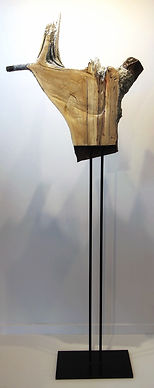
I developed this series of work thinking about the consequences of living in the Anthropocene; our living on a damaged planet. Being uprooted used to have as its primary reference the act of being removed, often forcefully, from one’s physical environment—the waves of refugees being a continuing and ubiquitous manifestation. Up-rootedness also has multiple, intersectional, emotional, psychological, and ecological, meanings that also call for comprehension.
The profound root-level interconnectedness of all life, now that it is under threat, is deeply astonishing, remarkable, and unsettling in its implications for how we are to live.
My method involves collecting tree roots, mostly salvaged from the burn pile of the town’s dump. Discarded as useless, the roots are cleaned, trimmed, and then painted gold. Gold has a long symbolic heritage that connotes more than just wealth. In Christian art, it represents light as well as purity and perfection. Across cultures, the metal is highly valued by the ancient Egyptians, and on across Africa, Asia, Europe, Oceania, and the Americas. Gold is thought to aid in healing, protection, growth, and knowledge. Covered then by whitish-grey wax the gold is “erased” with only traces remaining visible. Tips of the cut root ends are touched with red and bound with lead. Symbolically associated with death, lead is toxic. Mythologically it is also associated, however, with transformation and divination spells. The resulting pieces with the root ends inverted so that they now look like branches have multiple references and recognitions. They are ghost-like and may even recall a kind of chaos and vengeance in their Medusa-like allusions.
Some are mounted on chemistry stands, bringing the added dimension of “objective” clinical observation, experimentation, and dissection that has tended to dominate a good deal of the human approach to nature: being cold and dispassionate can no longer be considered virtues. This sense is emphasized by using the “scientific” language of Latin. Volsus (verb) has extracted, eradicated, rooted out, plucked, demolished, and uprooted among its meanings. The “Rx” used in medicine is also from Latin and means “recipe” and “to take.” The titles are thus a literal recognition of the reality of the roots “taken” from the ground and rendered as waste as part of the prevailing, capitalistic ideology of control and domination of nature. Yet, in this manifestation they haunt the viewer, troubling the divide between absence and presence. A prick to the conscience.

Uprooted Rosrchach
tree root/lead/acrylic/
wax/diamond head steel nails
48 ¾” x 30” x 14”

Sunflower Works
sunflowers with mix-media
12” (round) x 47.5”
.jpg)
Specimen G
Tree root (pine)/acrylic/wax/lead/
welded metal stand
26.5” x 70” x 10”

Horizon Line
patina on copper/acrylic/lead/burnt wood
10.75” x 12.25”
.jpg)
Sunflower Works (Bottom Detail)
sunflowers with mix-media
12” (round) x 47.5”

Specimen F
Tree root/acrylic/wax/lead/
metal stand
25” x 37” x 22”
.png)
Specimen E
tree root/acrylic/wax/
gauze/
lead/metal stand
26” x 28” x 27”

Situated for Examination
encaustic, tree root, lead, acrylic, stand 27” x 18” x 25”

Specimen C
tree root/acrylic/wax/lead/
welded steel
12” x 30” x 6”

Specimen D
tree root/acrylic/wax/lead/
welded steel
26” x 38” x 23”

Specimen B
tree root/acrylic/wax/lead/
welded steel
19” x 32” x 18”

Specimen A
tree root/acrylic/wax/
lead/welded steel
13” x 37.5” x 16”

Root Reach
lead/acrylic/tree root/encaustic
31” x 45”

Root Wound 2
lead/acrylic/tree root/gauze/encaustic
welded metal frame
18” x 20”

Root Wound 1
lead/acrylic/tree rood/gauze/encaustic
welded metal frame
18” x 20”

Root Wound 1
lead/acrylic/tree rood/gauze/encaustic
welded metal frame
18” x 20”
%20Experiment.jpg)
(Head and Heart) Experiment
encaustic, tree root, plant material, lead, tubing, acrylic, measuring stand
16” x 42” x 13”
2023
.png)
Divided (A River Once Ran Through It)
Lead, tree root, acrylic, encaustic, patina and dye on copper, nails
48” x 28 ¼”

Broken
lead/acrylic/tree root/gauze/encaustic
welded metal frame
18” x 20”

Leaf & Root
Small Ruins

Door 1
steel plate, bronze, patina, dye, acrylic
12” x 12
Door 2
steel plate, bronze, patina, dye, acrylic
12” x 12


Door 3
steel plate, bronze, patina, dye, acrylic
12” x 12
Door 4
steel plate, bronze, patina, dye, acrylic
12” x 12


Door 5
steel plate, bronze, patina, dye, acrylic
12” x 12
Door 6
steel plate, bronze, patina, dye, acrylic
12” x 12


Door 7
steel plate, bronze, patina, dye, acrylic
12” x 12
The Loneliness Series
In this series I wanted to explore loneliness based on photographs I have taken—mainly in rural Alberta, Canada. Each photograph, somewhat indistinct on the grey lead is replicated in the top part of the painting, but here, although the same size, the “photograph” or memory has been overtaken by a textured darkness even though it is surrounded by beauty

Landscapes of Loneliness: Winter
copper, Lead, mixed media on wood panel.
18.5” X 24.5“
Landscapes of Loneliness: Hospital
copper, Lead, mixed media on wood panel.
18.5” X 24.5“


Landscapes of Loneliness: Car
copper, Lead, mixed media on wood panel.
18.5” X 24.5“
Landscapes of Loneliness: Coat Hangers
copper, Lead, mixed media on wood panel.
18.5” X 24.5“


Landscapes of Loneliness: Funeral
copper, Lead, mixed media on wood panel.
18.5” X 24.5“
Landscapes of Loneliness: Intersection
18.5” X 24.5“
copper, Lead, mixed media on wood panel.

